
AQA A-Level Biology: The Mark Scheme Details That Could Be Costing You Marks
Oct 20, 2026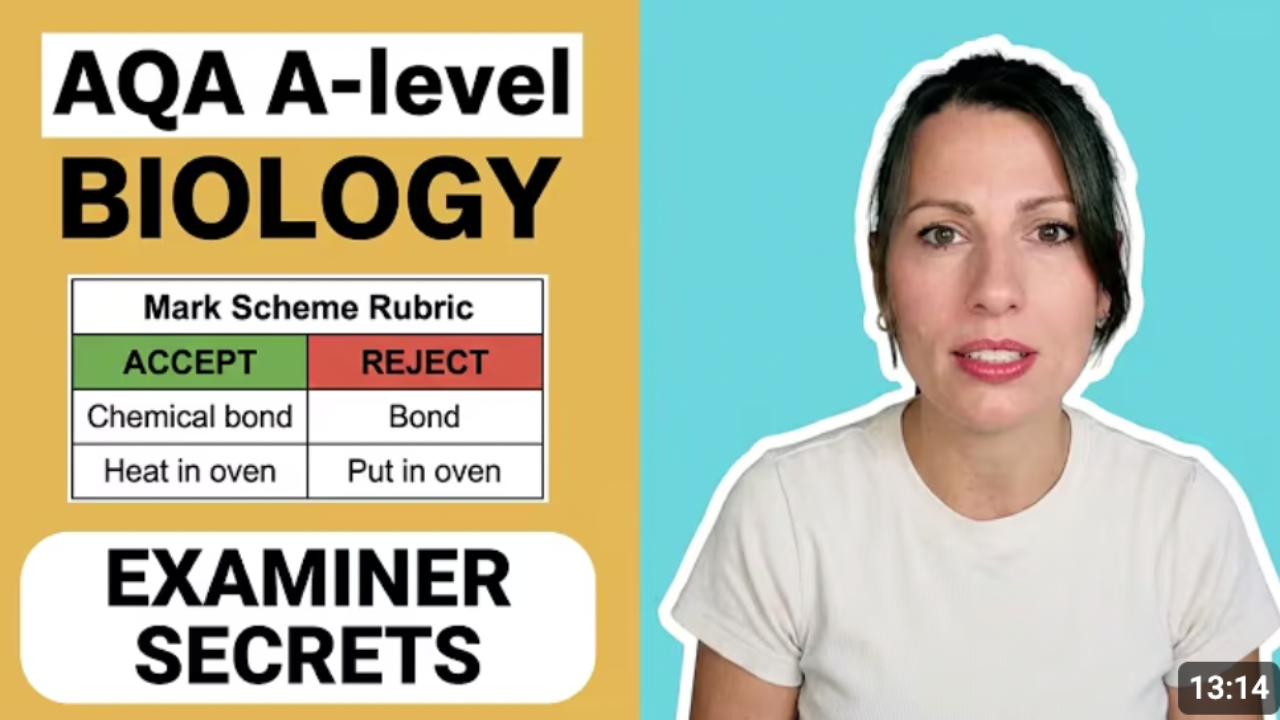
You can know the biology perfectly and still lose the mark.
Frustrating, isn't it?
You've revised the topic, learnt the processes and practised the questions. You know your stuff. Then you get your paper back, look at the mark scheme and discover that your answer was missing one tiny word.
Or perhaps you knew the process but didn't explain exactly where it happened. Maybe you remembered most of a definition but left off the final phrase worth the second mark.
After more than 15 years of teaching biology, I know how frustrating this can be. I also sit A-Level Biology exam papers and work through the mark schemes each year. When you look at them closely, you start to notice patterns in the level of precision expected.
The problem isn't always a lack of biological knowledge. Sometimes, it's knowing how to communicate that knowledge in the way the question requires.
In this guide, I'm sharing seven areas where small details can make a big difference to your AQA A-Level Biology answers.
Now, let's look at the details students often overlook.
1. Condensation and hydrolysis: It's a chemical bond
Let's start with Topic 1: Biological Molecules.
When you're asked to describe a condensation reaction, don't settle for a vague explanation about two molecules joining together.
Learn this definition:
A condensation reaction joins two molecules together with the formation of a chemical bond and involves the elimination of a molecule of water.
Notice the word chemical.
It might seem obvious that the bond formed is a chemical bond, but scientific answers need to be precise. Saying only that a bond forms may not satisfy the marking point being tested.
Hydrolysis is another definition worth learning carefully:
A hydrolysis reaction breaks a chemical bond between two molecules and involves the use of a water molecule.
Notice the difference between the two processes. Condensation involves the formation of a bond and the elimination of water, whereas hydrolysis involves breaking a bond using water.
While you're revising this part of the specification, make sure you can also define monomers and polymers.
Monomers: The smaller units from which larger molecules are made.
Polymers: Molecules made from a large number of monomers joined together.
Examples of monomers include monosaccharides, amino acids and nucleotides.
Miss Estruch's exam tip: Don't just learn the general idea of a definition. Practise writing the complete definition, including the small words that are easy to overlook.
2. Protein structure: Name the bonds
Still in Topic 1, let's look at proteins.
When describing the primary structure of a protein, it's important to include the sequence of amino acids and the bonds linking them.
A useful answer to learn is:
The sequence of amino acids in the polypeptide chain, held together by peptide bonds.
Remembering the sequence of amino acids is important, but don't forget to identify the peptide bonds.
It's also worth revising the bonds associated with the different levels of protein structure:
-
Primary structure: Peptide bonds link amino acids in the polypeptide chain.
-
Secondary structure: Hydrogen bonds help stabilise the structure.
-
Tertiary structure: Interactions include hydrogen bonds, ionic bonds and disulfide bridges.
When revising protein structure, practise explaining both what each level describes and which bonds or interactions help stabilise it.
Miss Estruch's exam tip: If a question asks you to describe a level of protein structure, check whether you have included the relevant bonds as well as the structural description.
3. Chemiosmosis: Where do the protons go?
Now for Topic 5: Energy Transfers in and Between Organisms.
Chemiosmosis appears in both oxidative phosphorylation during respiration and the light-dependent reactions of photosynthesis.
Students may understand that protons move down an electrochemical gradient through ATP synthase, but their answers can lack the specific locations needed to explain the process fully.
Let's separate the two processes.
Oxidative phosphorylation
During oxidative phosphorylation:
-
Protons are pumped from the mitochondrial matrix across the inner mitochondrial membrane into the intermembrane space.
-
This creates an electrochemical gradient across the inner membrane.
-
Protons move down their electrochemical gradient through ATP synthase embedded in the inner membrane.
-
The protons return to the mitochondrial matrix, and the flow of protons through ATP synthase drives ATP synthesis.
The light-dependent reaction of photosynthesis
During the light-dependent reaction:
-
Protons accumulate in the thylakoid space after being transported from the stroma and through processes involving the splitting of water.
-
An electrochemical gradient develops across the thylakoid membrane.
-
Protons move down their electrochemical gradient through ATP synthase.
-
They return to the stroma, driving ATP synthesis.
The key lesson is that you need to know the direction of proton movement and the compartments on either side of the membrane.
Miss Estruch's exam tip: When practising chemiosmosis questions, draw a simple membrane diagram and label the starting compartment, destination, electrochemical gradient and ATP synthase. Then practise explaining the process without looking at your notes.
4. Measuring biomass: Heat the sample
Still in Topic 5, let's look at measuring dry biomass.
If a question asks how to determine the dry mass of a sample, saying that you put it in an oven and weigh it is not a sufficiently precise method.
You need to explain what happens to the sample.
A useful method is:
-
Heat the sample in an oven to remove water.
-
Repeatedly weigh the sample.
-
Continue heating and weighing until it reaches a constant mass.
Why is the constant mass important?
It provides evidence that further heating is no longer causing a measurable loss of mass through water removal.
Notice the distinction between describing the equipment and describing the scientific method. Simply naming an oven doesn't explain the process you carry out.
Also, don't confuse measuring dry biomass with estimating the chemical energy stored in biomass. Calorimetry is used to estimate energy content, which is a different type of investigation.
Miss Estruch's exam tip: For practical-method questions, think about the sequence of actions, what you measure and how you know when the method is complete.
5. Muscle types: Don't mix up skeletal and cardiac muscle
Topic 6 introduces another important lesson: applying your knowledge to the correct biological example.
There are three main types of muscle tissue:
-
Skeletal muscle: Associated with the skeleton and responsible for moving it.
-
Smooth muscle: Found in the walls of various internal organs, including the small intestine, where it contributes to peristalsis.
-
Cardiac muscle: Found in the wall of the heart.
The sliding filament theory explains muscle contraction in skeletal muscle. It involves the interaction of actin and myosin filaments within sarcomeres.
The problem arises when students describe skeletal muscle contraction and then use the cardiac cycle as their example of its importance without making the appropriate distinction between the two muscle types.
Cardiac muscle is myogenic, meaning that the heart can initiate its own rhythmic contractions. You therefore need to be careful when transferring explanations of skeletal muscle contraction directly to cardiac muscle.
A more appropriate application of skeletal muscle knowledge is ventilation.
For example, the external intercostal muscles are skeletal muscles located between the ribs. Their contraction helps move the ribcage during inspiration.
This gives you a clear connection between the structure and function of skeletal muscle and its role in ventilation.
Miss Estruch's exam tip: In an essay, make sure your application genuinely follows from the biology you've described. A correct explanation linked to an inappropriate example can weaken an otherwise strong answer.
6. Population: Don't forget potentially interbreed
Moving on to Topic 7: Genetics, Populations, Evolution and Ecosystems.
A population is commonly defined as:
A group of organisms of the same species occupying a particular space at a particular time that can potentially interbreed.
There are several components to this definition:
-
The organisms belong to the same species.
-
They occupy a particular space.
-
They are present at a particular time.
-
They can potentially interbreed.
The final phrase is easy to leave out when you're writing quickly, but it can be important when the definition is assessed in separate marking points.
Don't learn only the beginning of a definition and assume that the rest is obvious.
Miss Estruch's exam tip: When revising definitions, break them into their essential components. Check that you can recall every part, rather than recognising the definition when you see it written down.
7. DNA probes: Remember complementary bases
Finally, let's look at Topic 8: The Control of Gene Expression.
DNA probes are used in techniques that locate specific DNA sequences, including sequences associated with particular alleles.
When describing a DNA probe, students can focus on the label attached to it and forget to explain how it recognises the target sequence.
A DNA probe is a short, single-stranded piece of DNA with a base sequence complementary to the target DNA sequence.
The key details to remember are:
-
It is a single strand of DNA.
-
Its bases are complementary to the target sequence.
-
It can be labelled so that its location can be detected.
The complementary base sequence is fundamental because it enables the probe to bind to its matching target sequence through complementary base pairing.
Simply stating that the probe is radioactively labelled, for example, does not explain how it identifies the sequence being investigated.
Miss Estruch's exam tip: When explaining a biological technique, don't just describe how a result is detected. Explain the biological principle that makes the technique work.
The pattern behind these mistakes
What do all seven examples have in common?
In each case, knowing the general biology is only part of the task. You also need to communicate the relevant details accurately.
When checking your answers, look out for these four problems:
1. Missing keywords
Have you included the specific term required, such as chemical bond or peptide bonds?
2. Incomplete definitions
Have you included every essential part of the definition, including phrases such as potentially interbreed?
3. Vague explanations
Have you identified where a process starts and finishes, rather than simply stating that something moves across a membrane?
4. Incorrect applications
Does your example genuinely match the biological process you have described?
These are useful questions to ask yourself whenever you practise AQA A-Level Biology exam questions.
How to revise mark scheme terminology effectively
Reading through a list of definitions is a useful starting point, but active practice is much more revealing.
Try this simple routine:
-
Choose a definition or process from your specification.
-
Write it out from memory without looking at your notes.
-
Compare your answer with a reliable mark scheme or specification-aligned resource.
-
Highlight any missing terms, incomplete phrases or incorrect locations.
-
Rewrite the answer and test yourself again later.
The aim isn't to memorise every possible mark scheme sentence blindly. It's to understand the biology and recognise the precise terminology and details that your answer needs.
Want to stop losing marks on the details?
This is exactly why I update my mark scheme-specific A-Level Biology flashcards to reflect the wording and details students need to know.
They're designed to help you practise key definitions and biological terminology, so you can spend less time wondering what an answer should include and more time building confidence in your exam technique.
Explore Miss Estruch's Mark Scheme-Specific Flashcard - AQA
Explore Miss Estruch's Mark Scheme-Specific Flashcard - OCR
Explore Miss Estruch's Mark Scheme-Specific Flashcard - AQA GCSE
Explore Miss Estruch's Mark Scheme-Specific Flashcard - Combined GCSE
Final Thoughts
Remember: don't just ask yourself whether you understand the biology. Ask yourself whether you can explain it clearly, accurately and with all the important details included.
Happy studying!
Miss Estruch
P.S. Are You A Visual Learner?
If you'd rather watch than read, you can find the YouTube Video this blog is based on here.
Author


