
GCSE and A-Level Reform Update: What Teachers Need to Know
Oct 20, 2026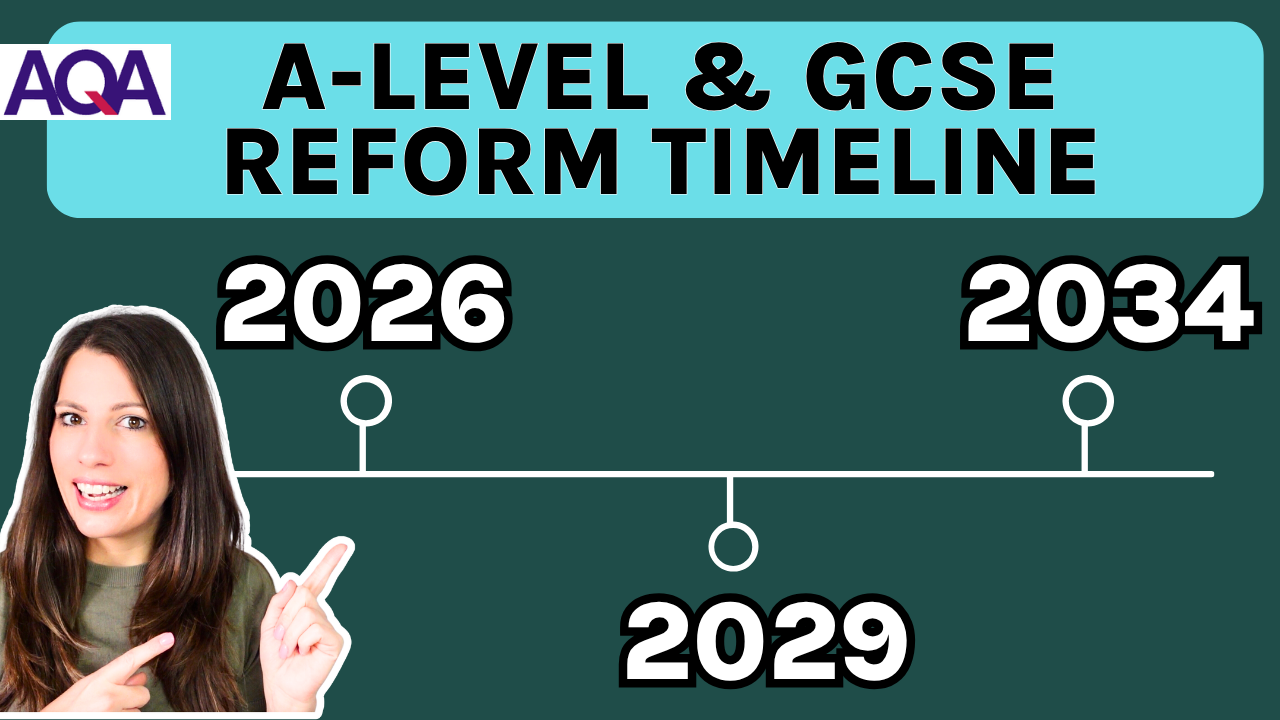
GCSE and A-level reform is gathering pace, and although the biggest changes are still a few years away, there are already important developments that teachers and school leaders need to understand.
Following the AQA Science Conference in June 2026, I’ve been going back through my notes to pull together the key updates on curriculum reform, assessment changes, performance measures and the future of practical science.
There is a lot to unpack, and not everything is confirmed yet. Some changes have an established timeline, others remain proposals, and several important details are still being worked through.
So, in this episode of Miss Estruch Teach & Tell, I’m breaking down what we know so far, when the changes are expected to happen and what they could mean for your classroom and department.
And consider this part one: as more detail emerges, there will be more to come.
1. The Big Picture: A National Curriculum and GCSE Rewrite
Let's start with the headline development.
England is moving towards a revised national curriculum and reformed GCSEs, AS and A-levels, following the Curriculum and Assessment Review.
The aim is to update what pupils learn and how their knowledge and skills are assessed. For teachers, this means a substantial period of curriculum development, consultation and preparation rather than a sudden change to everything we teach.
The Department for Education (DfE) has set out a phased approach:
-
The revised national curriculum is planned for publication in spring 2027.
-
Schools are expected to begin teaching the revised national curriculum at key stages 1–3 in September 2028.
-
The first reformed GCSEs are scheduled for first teaching in September 2029, followed by a second phase in September 2030.
-
A-level reform is scheduled to follow, with first teaching of Phase 1 subjects in September 2031 and Phase 2 subjects in September 2032.
The important point is that the changes will not all happen at once. The process is being phased to give schools, awarding organisations and teachers time to prepare.
For science departments, that means keeping informed now, without feeling that every existing scheme of work needs to be rewritten immediately.
2. The Full GCSE and A-Level Reform Timeline
If you're a head of department, curriculum lead or classroom teacher, this is the timeline worth keeping close to hand.
| Stage | Expected first teaching | First examinations |
|---|---|---|
| GCSE reform – Phase 1 | September 2029 | Summer 2031 |
| GCSE reform – Phase 2 | September 2030 | Summer 2032 |
| A-level reform – Phase 1 | September 2031 | Summer 2033 |
| A-level reform – Phase 2 | September 2032 | Summer 2034 |
These dates reflect the planned implementation timetable, rather than a guarantee that every subject will change in exactly the same way. The reforms are being phased across selected subjects, with the detail to be confirmed through the relevant development and consultation processes. See the DfE's curriculum reform plans.
For A-level teachers, the key takeaway is that the earliest planned first teaching date for Phase 1 is September 2031.
That might feel a long way off, particularly when you're already juggling exam preparation, practical work, marking and department priorities. However, the decisions made during the consultation and specification-development stages will eventually influence what we teach, how we teach it and how students are assessed.
Being aware of the timeline now puts you in a much better position to contribute to those conversations.
3. What Happens Between Now and 2029?
Knowing that reform is coming is one thing. Understanding what happens in the meantime is much more useful.
Here is the broad implementation plan discussed at the conference.
2026: Consultation and development
The DfE is developing draft subject content and working with awarding organisations as the new curriculum and qualifications take shape.
Consultation is a crucial part of this process. It gives teachers, schools and other stakeholders an opportunity to consider the proposals and provide feedback before the final content is agreed.
Ofqual is also involved in the assessment side of reform, including the arrangements that will govern the new qualifications.
What this means for teachers: Stay informed, look out for consultation opportunities and consider how proposed changes could affect your subject and your students.
2027: Final curriculum content
The revised national curriculum and Phase 1 GCSE subject content are planned for publication in spring 2027.
Awarding organisations will continue developing their specifications and assessment materials, with accreditation processes forming part of the preparation for the new qualifications.
This is when schools should start to gain a clearer picture of what the changes mean at subject level.
2028: Preparation and planning
The revised national curriculum is expected to be introduced at key stages 1–3 from September 2028.
For secondary schools, this will also be an important period for preparing for the first reformed GCSEs. Final accredited specifications for Phase 1 qualifications are expected to become available ahead of first teaching.
Departments will need to consider curriculum sequencing, assessment approaches, resources and staff development as the detail becomes available.
2029: The first reformed GCSEs arrive
September 2029 is the planned first-teaching date for Phase 1 GCSEs.
The second phase of GCSE reform is scheduled to follow in September 2030, with A-level reform beginning in 2031.
The short version: The next few years are about consultation, development and preparation. The first Phase 1 GCSE changes are planned to reach classrooms in 2029.
4. Assessment Changes: What Could Affect Teachers Sooner?
While the curriculum rewrite is a longer-term project, some assessment developments are much closer to home.
These are worth paying attention to because they could influence how students approach examination questions before the new qualifications arrive.
Formulae and equation sheets
Ofqual has set out requirements around the publication and provision of formulae and equation sheets for relevant examinations.
One important principle is that students should not simply be able to copy information directly from a supplied sheet and receive credit without demonstrating their understanding.
From 2028, the planned approach means that questions should require students to apply the information provided, rather than being answerable solely by transferring it from the formulae or equations sheet. Teachers should check the relevant awarding organisation's guidance for the subjects and examination series they teach.
For science teachers, this reinforces something we already know: giving students a formula does not remove the need to understand what it means, when to use it and how to apply it to an unfamiliar problem.
Showing working in Physics and Chemistry
Another assessment point highlighted at the AQA conference was the use of the instruction “you must show your working” in extended-response and multi-step calculation questions in Physics and Chemistry.
The change discussed applies to questions worth four, five or six marks that require at least two equations.
Showing working is not just about making an answer easier for an examiner to follow. It can also help students access credit for correct stages of a calculation, even when the final answer is incorrect.
This is a valuable reminder for teachers to model full working consistently, rather than focusing only on reaching the correct numerical answer.
What can you do now?
-
Make showing working a routine in lessons and homework.
-
Model the stages of multi-step calculations.
-
Encourage students to include units and appropriate rounding.
-
When reviewing exam questions, discuss where credit can be earned throughout a calculation.
These habits are useful regardless of the wider reform timeline.
5. Progress 8 and Attainment 8: What's Being Proposed?
Curriculum reform is not just about the content of qualifications. It also raises questions about how schools are measured and held accountable.
The DfE has proposed changes to Progress 8 and Attainment 8, including a different approach to the subjects that contribute to performance measures.
Under the proposals discussed at the conference, English and maths would retain their existing position, while science would have two dedicated slots alongside four breadth slots.
At least two of the breadth slots would need to come from two of three categories:
-
Humanities
-
Creative subjects
-
Languages
The DfE has also sought views on whether a fourth category should be introduced specifically for science subjects, including computer science.
It is important to distinguish between a proposal and a confirmed policy. These ideas indicate the direction of the discussion, but the final arrangements depend on the government's decisions and the relevant consultation process.
Why should science departments pay attention?
Performance measures influence curriculum planning, option choices and wider conversations about the balance of subjects offered by a school.
Any changes to the way science is represented in accountability measures could therefore have implications beyond the science department itself.
For heads of department and senior leaders, this is one to monitor as the proposals develop.
6. V Levels: A New Vocational Pathway
One of the nearer-term developments concerns post-16 education.
V Levels are being introduced as a new vocational pathway alongside A-levels and T Levels. They are intended to give students another route into further study and employment, with qualifications designed around vocational subject areas.
The first V Levels are scheduled for introduction in September 2027, with initial subject areas including education, accounting and finance, and digital systems and data. Further subjects are expected to follow as the programme develops.
The qualifications are designed to be equivalent in size to one A-level, allowing students to combine V Levels with A-levels where appropriate.
Alongside V Levels, the government is developing new Level 2 Foundation Certificates and Occupational Certificates, intended to provide different progression routes into further study or skilled employment.
For schools and colleges, these developments raise practical questions about post-16 pathways, careers guidance, curriculum planning and the choices available to students.
If you work with Year 11 students or contribute to post-16 guidance, this is worth following now rather than waiting until the qualifications are already being taught.
The DfE's Post-16 Pathways Implementation Plan provides further information about the rollout and planned implementation.
7. Practical Science: What Is AQA Reviewing?
For science teachers, one of the most interesting discussions at the conference concerned practical work.
Practical science is central to how students develop scientific understanding, but delivering it consistently across schools can be challenging.
Technician capacity, budgets, specialist equipment and teacher confidence all influence what is possible in a real classroom.
The challenge for AQA is to consider how practical work and its assessment can be developed in a way that is educationally valuable and realistic for schools to deliver.
The conference discussion highlighted three areas for review:
-
Apparatus and techniques: reviewing the expectations around the practical skills students should develop.
-
Required Practicals: reviewing the current approach and considering whether changes are needed.
-
Assessment: developing questions that reward students' understanding of practical work and the learning it provides, rather than simply testing their ability to recall a method.
One point worth emphasising is that this discussion was not a return to NEA. The focus was on considering how practical learning and assessment might work more effectively.
There are differing views across the sector. Some centres value the existing Required Practicals, while others have concerns about resources, delivery and the relationship between practical experience and examination assessment.
For teachers, the key is to watch how the review develops and look for opportunities to contribute practical experience from the classroom.
The aim should be an approach that genuinely supports students' scientific understanding while remaining deliverable in schools with different levels of resources and capacity.
8. Climate Literacy: A Wider Role for Science Education
Another thought-provoking part of the conference was the keynote from Professor Sylvia Knight of the Royal Meteorological Society.
Her message was that climate literacy should not simply be treated as an additional topic to squeeze into an already crowded curriculum.
Instead, students should develop an understanding of how the climate system works, how human activity affects it and how climate change influences people and ecosystems.
This means applying a climate perspective across existing science content where it is relevant.
For example, climate literacy can connect with topics involving energy transfer, ecosystems, carbon cycling, atmospheric processes and the effects of human activity on the environment.
However, embedding this meaningfully into teaching presents challenges.
These include:
-
Limited curriculum time.
-
The way knowledge is assessed.
-
Teacher confidence and subject knowledge.
-
Access to suitable classroom resources.
-
Concerns about controversy or how discussions may be received.
-
The need for support from school leadership.
Climate literacy is also expected to feature in PISA 2029, making it an area worth following as the wider curriculum develops.
For science departments, the opportunity is to consider where climate-related examples can strengthen students' understanding of the science they already study, rather than treating climate change as an isolated subject.
9. What Should Teachers and Heads of Department Do Now?
With so many changes being discussed, it is easy to feel that you need to act on everything immediately.
You don't.
The most useful approach is to separate what is happening now from what is planned for the future and what is still under consultation.
Here are five practical steps to take.
1. Keep a clear reform timeline.
Make a note of the key dates for curriculum publication, consultation, specification development and first teaching. This will help you plan ahead without making premature changes.
2. Monitor official updates.
Use information from the DfE, Ofqual and AQA to distinguish confirmed decisions from proposals and early-stage discussions.
3. Build assessment habits now.
Encourage students to show their working, apply formulae rather than simply recall them, and explain their reasoning clearly. These are valuable skills regardless of future specification changes.
4. Start department conversations, not wholesale rewrites.
It is reasonable to discuss curriculum priorities, practical provision and potential implications for staffing or resources. However, avoid rewriting schemes of work before the relevant subject content and specifications are available.
5. Take part in consultation where possible.
Teachers understand the practical realities of delivering a curriculum. Sharing informed feedback can help ensure that proposed changes are workable for schools and beneficial for students.
10. There Is More to Come
One of the most important things to remember about education reform is that the details evolve.
At the time of the AQA Science Conference in June 2026, several elements were still moving through consultation and development. Some proposals have since progressed, while other details remain subject to decisions and further guidance.
That is why it is important to keep checking the latest official information rather than treating an early announcement as the final position.
I will continue following the developments, particularly the subject-content consultations, assessment arrangements and what the practical science review could mean for classroom teaching.
As more information becomes available, I'll bring you the updates that matter most to teachers and school leaders.
Final Thoughts
The overall picture from the summer is one of substantial long-term reform, alongside some assessment developments that deserve attention much sooner.
The planned timeline runs from the current consultation and development stages through to the first reformed GCSEs in 2029 and the first reformed A-level examinations in 2033 and 2034.
V Levels are due to arrive earlier, in September 2027, while discussions about Progress 8, practical science and climate literacy raise important questions about the future of curriculum planning.
My advice is simple: stay informed, separate confirmed changes from proposals, and make use of the time available to prepare thoughtfully.
You do not need to have every answer today. You do need to know where to find reliable information and when the next important decisions are expected.
If you found this useful, share it with a colleague or someone in your department who needs a straightforward overview of what's happening.
And make sure you're subscribed to Miss Estruch Teach & Tell, because this is only part one. As the detail lands, we'll keep working through what it means for your classroom, your students and your workload!
Happy teaching!
- Miss Estruch
Sources and further reading
-
Department for Education: Government response to the Curriculum and Assessment Review
-
Department for Education: Post-16 Pathways Implementation Plan
Note: Reform dates and proposals may change as consultations conclude and official guidance is updated. Always check the latest information before making curriculum or assessment decisions.
Author


